

What Is a Chronograph Watch? How It Works and How to Use a Tachymeter
Why trust this guide? It's written by the Watch Direct team, an authorised Australian watch retailer trading since 2011. Technical explanations are checked against manufacturers' instruction manuals (Seiko and Citizen) and respected watch references, including Hodinkee, Monochrome and COSC.
Featured watches were checked for stock and specifications on our store when this guide was written in October 2026.
At a Glance
- A chronograph is a watch with a stopwatch. It times events without affecting the normal time display.
- Pushers control it: usually 2 o'clock to start and stop, 4 o'clock to reset.
- Sub-dials count the minutes (and sometimes hours) while the big central hand counts seconds.
- A tachymeter turns time into speed: time one kilometre, read the scale, and you have km/h.
- Chronograph is not chronometer. One is a stopwatch, the other an accuracy certificate.
In This Guide
What is a chronograph?
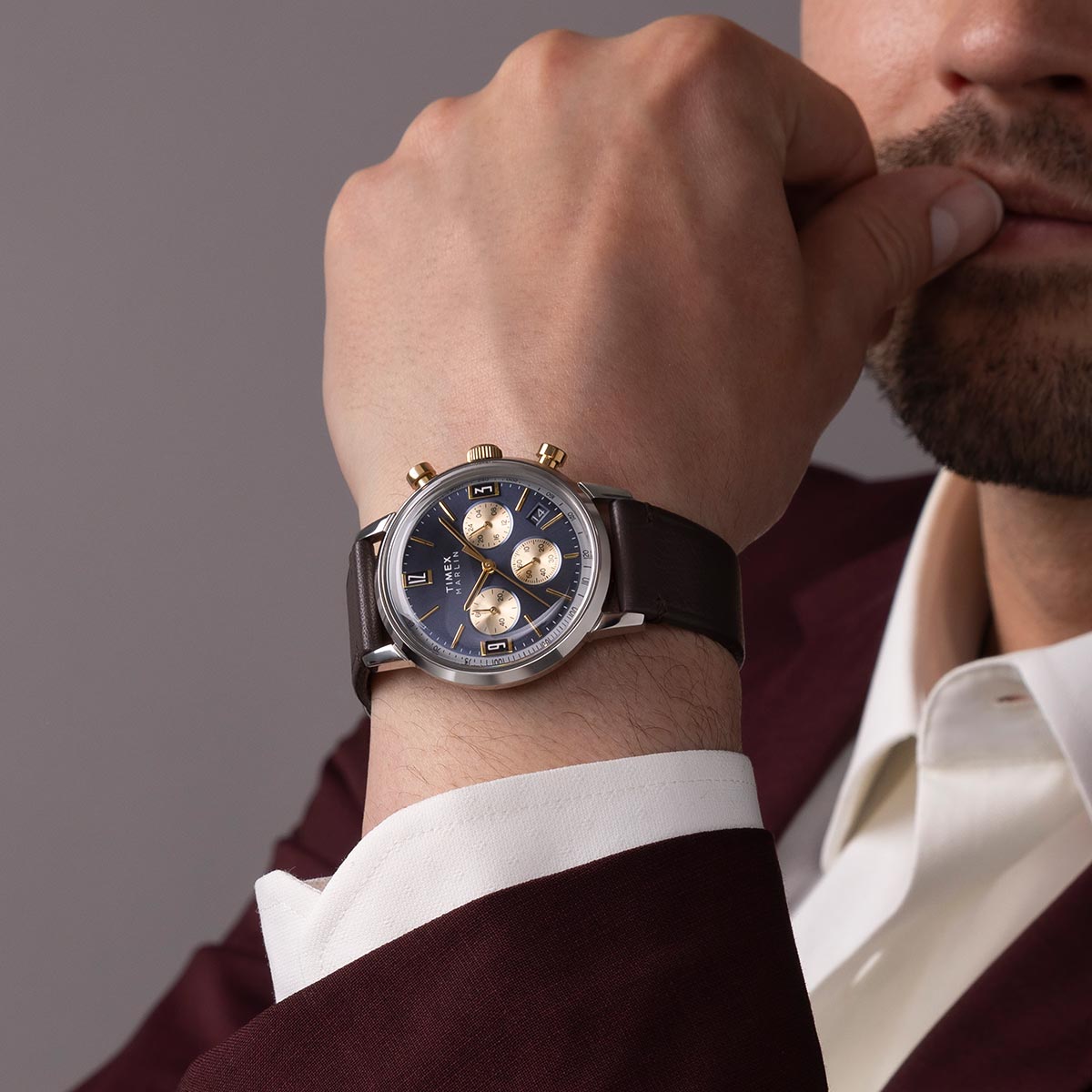
A chronograph is a watch with a built-in stopwatch. You can time a lap, a parking meter or a pot of pasta while the hour and minute hands carry on telling the time. The name comes from the Greek chronos (time) and graph (writing). You'll recognise most chronographs by two pushers beside the crown and two or three small sub-dials on the face.
The parts of a chronograph
- Start/stop pusher, usually at 2 o'clock. Press once to start, again to stop.
- Reset pusher, usually at 4 o'clock. Returns the chronograph hands to zero.
- Chronograph seconds hand, the large central hand that stays at 12 until you start timing. On many watches, the everyday running seconds move to a small sub-dial instead.
- Minute counter, a sub-dial that records elapsed minutes, often up to 30 or 60.
- Hour counter, a sub-dial on some models for longer events.
- Scales such as a tachymeter, printed on the bezel or the outer edge of the dial.
How to use a chronograph
The basic sequence is the same on most watches. This example follows Citizen's instructions for its calibre 0520, which measures up to 59 minutes 59 seconds in one-second steps:
- Start: press the start/stop pusher. The chronograph seconds hand begins to sweep.
- Stop: press the same pusher again to stop timing and read the result.
- Restart (optional): press it once more to carry on from where you stopped.
- Reset: once stopped, press the reset pusher to return the hands to zero.
To read the time, add the minute counter to the position of the central seconds hand. If the minute counter shows 3 and the seconds hand points to 25, the elapsed time is 3 minutes 25 seconds. Some quartz and solar chronographs measure much finer intervals. The Seiko Speedtimer SFJ003P, for example, times to 1/100 of a second for up to 60 minutes.
If the chronograph hands don't sit exactly at zero after a reset, for example after a battery change or a knock, most quartz chronographs have a zero-positioning procedure in the manual.
What is a tachymeter, and how do you use it?
A tachymeter is a scale, usually around the bezel or the edge of the dial, that converts the time taken to cover a known distance into an average speed. It works because speed per hour equals 3,600 divided by the seconds taken.
- Start the chronograph as you pass a marker, such as a kilometre post.
- Stop it when you pass the next marker, one kilometre later.
- Read the tachymeter number next to the chronograph seconds hand. That's your average speed in km/h.
30 seconds
Tachymeter reading: 120 · Average speed: 120 km/h
40 seconds
Tachymeter reading: 90 · Average speed: 90 km/h
45 seconds
Tachymeter reading: 80 · Average speed: 80 km/h
60 seconds
Tachymeter reading: 60 · Average speed: 60 km/h
| Time for 1 km | Tachymeter reading | Average speed |
|---|---|---|
| 30 seconds | 120 | 120 km/h |
| 40 seconds | 90 | 90 km/h |
| 45 seconds | 80 | 80 km/h |
| 60 seconds | 60 | 60 km/h |
Over two kilometres, multiply the reading by two. Over half a kilometre, halve it. The scale only works for times under 60 seconds, so it suits faster speeds. You can also use it for rates: if a task takes 45 seconds, the scale reads 80, meaning about 80 per hour.
You may also see a telemeter scale (distance to a sound source such as thunder, based on the speed of sound) or a pulsometer scale (heart rate). Tachymeters are by far the most common.
Chronograph vs chronometer
The two words are often confused. A chronograph is a function: a stopwatch. A chronometer is a watch whose movement has passed official accuracy testing. In Switzerland that's done by COSC, the Swiss official chronometer testing institute. A watch can be a chronograph, a chronometer, both or neither. Most of the chronographs you'll see are not chronometer-certified, and that's perfectly normal.
Types of chronograph
- Quartz chronographs are battery-powered, accurate and affordable, and often time to fractions of a second.
- Solar chronographs, such as Seiko's calibre 8A50, charge from light. Seiko quotes about six months of running on a full charge for the SFJ003P.
- High-performance quartz, such as Bulova's 262 kHz movements, vibrates far faster than standard quartz for greater accuracy.
- Mechanical chronographs, either hand-wound or automatic, use a mechanical module to drive the timing hands.
- Flyback chronographs reset and restart in a single press, without stopping first.
- Split-seconds (rattrapante) chronographs have a second timing hand, so you can time two events that start together.
Chronographs we recommend
Three chronographs that show the main types: solar, high-performance quartz and classic quartz.

Seiko Prospex · Solar · 1/100-sec chronograph
Seiko Prospex Speedtimer SFJ003P
Inspired by Seiko's 1969 Speedtimer, this solar chronograph charges from light and times to 1/100 of a second.
- Calibre: 8A50 solar
- Chronograph: 1/100 sec, up to 60 minutes
- Crystal: Curved sapphire
- Water resistance: 100m
- Case: 42mm stainless steel

Bulova · High-performance quartz · Tachymeter
Bulova Lunar Pilot 96B251
Bulova says it's inspired by the chronograph worn by Apollo 15's mission commander in 1971, updated with its 262 kHz high-performance quartz.
- Movement: 262 kHz high-performance quartz
- Scale: Tachymeter
- Crystal: Sapphire
- Water resistance: 50m
- Case: 45mm stainless steel, two straps

Citizen · Quartz · 1-sec chronograph
Citizen Chronograph AN8174-58E
A classic two-tone dress chronograph with a black dial and a simple, easy-to-learn chronograph.
- Calibre: 0520 quartz
- Chronograph: 1 sec, up to 60 minutes
- Crystal: Mineral
- Water resistance: 100m
- Case: 40mm stainless steel
Featured chronographs compared
| Type | Watch | Timing | Tachymeter | Water resistance |
|---|---|---|---|---|
| Solar | Seiko SFJ003P | 1/100 sec, 60 min | Not stated | 100m |
| High-performance quartz | Bulova 96B251 | Chronograph | Yes | 50m |
| Quartz | Citizen AN8174-58E | 1 sec, 60 min | Not stated | 100m |
Explore chronographs
Frequently asked questions
What does a chronograph do on a watch?
A chronograph is a stopwatch built into a watch. You start, stop and reset it with pushers on the side of the case, and it measures elapsed time on its own hands and sub-dials while the watch keeps telling the time as normal.
What is the difference between a chronograph and a chronometer?
A chronograph is a function: a stopwatch. A chronometer is a certification for accuracy. In Switzerland, the official testing body COSC certifies movements as chronometers after precision tests. A watch can be one, both or neither.
How do you use a tachymeter?
Start the chronograph as you pass a starting point and stop it after a known distance, such as one kilometre. The number on the tachymeter scale next to the chronograph seconds hand is your average speed in kilometres per hour. It only works for times under 60 seconds.
What does chronograph mean?
The word comes from the Greek 'chronos' (time) and 'graph' (writing). Today it simply means a watch with a stopwatch function.
Can I leave the chronograph running all the time?
It's best not to. On quartz chronographs, a running chronograph uses extra battery power. Citizen, for example, advises stopping and resetting the chronograph promptly when you've finished timing, because leaving it running wears the battery down sooner.
Which pusher starts the chronograph?
On most chronographs, the pusher at 2 o'clock starts and stops timing, and the pusher at 4 o'clock resets it. Layouts vary, so check your watch's manual, and stop the chronograph before you reset it unless your watch is a flyback.
Authorised Retailer
Why buy your watch from Watch Direct?
We've been an authorised Australian watch retailer since 2011. Every watch comes with the manufacturer's warranty, free standard shipping Australia-wide and 30-day returns.
Shop Chronographs → Shop Seiko Chronographs → Shop Men's Watches →